Showing posts with label side story. Show all posts

Saturday, November 15, 2014

Side Story 2-1: Do You Construct, or Do You Freehand?

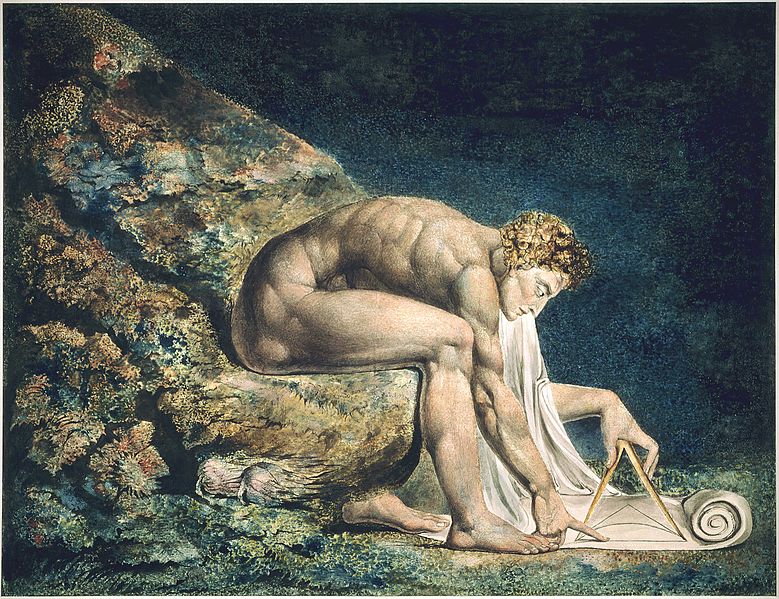
Newton by William Blake. Public domain.
By using only compass and straightedge, you become part of an ancient tradition.

Quick Question:
Do you prefer using a compass and a straightedge to draw geometric diagrams, or would you rather freehand?

Most of the people I know freehand. I would posit that the simple reason is that geometric construction isn't a topic touched upon at great length in most of our classrooms, and dabbling with the compass is mostly done in drafting class (that is, if you had one; I didn't.). When it comes, however, to people who deal with more elaborate [Difficulty 4+ in this blog] geometry problems on a regular basis, the question does become a tad more relevant. The figures get quite complicated, and for some, the best way to make any sense out of anything is to draw them as precisely as possible. Hence constructing.

Friday, October 31, 2014

The High School Gap

See you on the other side.

DISCLAIMER
While I’ve observed this phenomenon independently early on, I cannot take credit for being the first to point it out. I first heard the version I will be elaborating on in Mar del Plata, July 2012. The diagrams, further explanation, and tips below, however, are my original work.
I am not (yet) an expert in mathematics education, and the explanations and diagrams below come from my personal observations and not from any formal study. If you want to subject this phenomenon to research, however, do consider e-mailing me. I’d be happy to help!


Friday, October 10, 2014

Mathletes’ Greatest Secrets Finally Revealed Episode 6: Mathematics Olympiad Summer Camp

Mathletes’ Greatest Secrets Finally Revealed
Episode 6: Mathematics Olympiad Summer Camp
first | previous | all | next | last >
Henry


Screenshot from imo-official.com
If you make it all the way, your name ends up on this site. For better or for worse. Forever.

Each year the Mathematics Olympiad Summer Camp selects and trains the Philippine Team for the International Mathematical Olympiad.

If you’re a high school senior, this will probably the last training-contest circuit you will be doing before entering university. Everybody else in your batch will have hung the gloves before you do. Know that whatever happens, you’ve been given the rare honor of staying in the ‘Math Games’ until the very end.

Mathletes’ Greatest Secrets Finally Revealed Episode 5: Philippine Mathematical Olympiad

Mathletes’ Greatest Secrets Finally Revealed
Episode 5: Philippine Mathematical Olympiad
first | previous | all | next | last >
Henry
Image Credit: "weird pi sculpture at the lavender farm" by Brian Ellin. Licensed under CC BY-NC-SA 2.0.

The letter pi is a apt motif that recurs in each yearly iteration of the PMO logo.
The Philippine Mathematical Olympiad is the premier mathematics contest for high school students in the country. Among the contests and programs we’ve discussed, only this one bears the legitimacy of being the country’s national Olympiad.

Saturday, October 4, 2014

Mathletes’ Greatest Secrets Finally Revealed Episode 4: Mathematics Trainers' Guild

Mathletes’ Greatest Secrets Finally Revealed
Episode 4: Mathematics Trainers' Guild
< first | previous | all | next | last >
Henry


(Image credit: publicdomainpictures.net)
YMIITP often brings participants to interesting locales around the country.


The Mathematics Trainers’ Guild offers one of the largest scale training programs in the country, and sends participants to a large variety of international events. It also keeps quite a high profile – if you perform, you will likely see your name in the papers.

Friday, September 12, 2014

Mathletes’ Greatest Secrets Finally Revealed Episode 2: School and University Hosted Contests

Mathletes’ Greatest Secrets Finally Revealed
Episode 2: School and University Hosted Contests
first previous all | next last >

[PDF/Printable] coming soon!
Henry


(Image credit: P. Cowie. Public Domain.)
Tip #1: Keep a formula notebook (see below). You'll find it useful, and so will archaeologists 3500 years later.

I will be discussing this sort of contest (e.g. Sipnayan, Lord of the Math, et al) at once, as there are so many and doing them one at a time would needlessly prolong the series and bore you, my precious readers. There are also other contests that contain math among many subjects; if you’re performing well in the math-only contests, the math there should be manageable.
Back to math-only contests. These are usually organized by a student organization within the school, with varying levels of support from the resident math department.
Again as an NCR resident, most of my examples will be NCR contests. Contests elsewhere of this nature should hopefully not be too different.

Friday, September 5, 2014

Mathletes’ Greatest Secrets Finally Revealed Episode 1: Eight Myths About Mathletes

Mathletes’ Greatest Secrets Finally Revealed
Episode 1: Myth Slaying, or Eight Myths About Mathletes
first previous all | next last >
Henry


(Image credit: Cornelis Cort. Public domain.)
Don't let new myths pop up where old ones die. Vanquish some myths today!

Before we tackle some actual contests, I’d like to dispel some common myths about competing in mathematics.

Myth #1

In a word: no. Hard work and true determination can more than take the place of talent.

Myth #2
We really can’t tell. Many questions in competitive mathematics go beyond standard exercises and speed drills. I’d say it’s safer to subscribe to a competitive math program, or get some books on the topic. At any rate, your obscenely fast arithmetic will be an advantage anywhere.

Friday, August 29, 2014

Mathletes’ Greatest Secrets Finally Revealed Episode 0: Introduction - Why Compete?

Mathletes’ Greatest Secrets Finally Revealed
Episode 0: Introduction - Why Compete? 
< first | previous | allnext | last >
Henry


Everest North Face toward Base Camp Tibet Luca Galuzzi 2006.jpg

To echo a famous mountaineer: it's there -- will you climb?

Preliminaries

If you’re reading this, one of these things has happened:
  • You want to be the very best (in math), that no one ever was!
  • You’ve been admitted into your school math varsity and you want to know what you got yourself into.
  • You’ve accumulated experience in a few contests, but you’re stuck in a rut and you don’t know what the next step is.

Saturday, December 21, 2013

Side Story 1-2: Museum Curios

There's AM-GM. Pigeonhole. Invariance. Muirhead (to a certain extent). These are tactics and tools to swear by - use them well, and they will grant you powers beyond your wildest dreams. They will bring you places.

Then there are these theorems. Some of them are mere museum curios; I've never encountered them in any question thrown to me.

For someone who collects theorems like stamps, it is the grandest moment when a problem demands that you cockily brandish your new-found weapon of mass deduction. Especially if you've mustered the temperance to prove it yourself without consulting Google, and succeeded. More especially if you forged the masterpiece yourself. (Of course, mindlessly applying theorems is the antithesis of competitive maths.) Hence, I always find it pitiful that a few cool-looking tools end up unused, like some sort of Chekhov's Gun left hanging in the wall as the curtain falls.

Of course, all this is relative. Contests change all the time; tools could rise and fall in utility. Moreover some will say my being a mere tenderfoot in the Math Games makes me fancy rare, endangered beasts out of the standard wildlife. And I will have to grudgingly say that that's plausible.

Lagrange's Identity.
$$ \left(\sum_{k=1}^{n}a^2_{k}\right)  \left(\sum_{k=1}^{n}b^2_{k}\right) - \left( \sum_{k=1}^n a_k b_k \right)^2  = \sum_{i=1}^{n-1} \sum_{j=i+1}^n (a_i b_j - a_j b_i)^2 = \frac{1}{2} \sum_{i=1}^n \sum_{j=1}^n (a_i b_j - a_j b_i)^2  $$
Granted its similarity to the vaunted Cauchy-Schwarz Inequality, I thought this beautiful identity would figure more into algebra problems. Alas, to the best of my memory, I have never had to use it. Still, it is intuitive, and lends much insight into how things multiply out.

Fibonacci is a Square

Ira Gessel's Problem H-187:
A positive integer $n$ is a Fibonacci number if and only if either $5n^2+4$ or $5n^2-4$ is a square.
It is intuitive to surmise that this very beautiful statement has found applications in computer science. I've never had the joy of finding it to be the crux of some problem, though.


Beatty's theorem.
Given two positive irrational reals $\alpha$ and $\beta$ so that $1/\alpha + 1/\beta = 1$, the sets $\left\{ \left\lfloor \alpha\right\rfloor ,\left\lfloor 2\alpha\right\rfloor ,\left\lfloor 3\alpha\right\rfloor \ldots\right\}$ and $\left\{ \left\lfloor \mathbf{\beta}\right\rfloor ,\left\lfloor 2\beta\right\rfloor ,\left\lfloor 3\beta\right\rfloor \ldots\right\} $ form a partition of the real numbers. 
 Who would have thought? It bears a certain likeness with that problem of a walking person with an irrational footstep destined to fall into the single pothole of an otherwise smooth planet.

Routh's theorem.

$$A = \left[ ABC \right]\left( \frac{(xyz - 1)^2}{(xz + x + 1)(yx + y + 1)(zy + z + 1)}\right)$$

This should have been useful. I surmise that only pure chance was behind my never being able to use this gem of a theorem. There's little point in memorizing it, since mass points and area formulae could bring about the same result.

The Hermite Identity.
$$\sum_{k=0}^{n-1} \left\lfloor x+\frac{k}{n} \right\rfloor = \left\lfloor nx \right\rfloor$$

Bordering between "it makes sense" and "really?!", we have the intuitive Hermite identity.


Do comment if you've had similar experiences with some cool but impractical theorems.

Saturday, December 7, 2013

Side Story 1-1: Five Signs You're a Matured Mathlete


1. You retain a fetish for $\mathrm{\LaTeX}$.
Microsoft Equation has become superb and easy to use, but nothing can really beat the oomph of sexily typeset mathematics (or chemistry, or physics):

$$ i\hbar\frac{\partial}{\partial t} \Psi(\mathbf{r},t) = \left [ \frac{-\hbar^2}{2m}\nabla^2 + V(\mathbf{r},t)\right ] \Psi(\mathbf{r},t)$$Look at my pretty equation, ye mighty, and despair!

(Sorry, Shelley.) Back in the day, to typeset in $\mathrm{\LaTeX}$ was to be the Voice of Unerring Authority. Today, well, it's still pretty (for me, at least). And it still commands a sort of respect from the reader (Me, at least. But who can't appreciate good vector renderings?) Sure, I might just be saying $\int e^x = f_u\left(n\right)$, but the typesetting nevertheless screams, "I am serious about my math". (But then I wouldn't be; I missed a differential $\mathrm{d}x$ over there.)

2. Math jokes aren't funny anymore.
After more than a few summers training, you have probably encountered so many math jokes, that the ones circulating on Facebook have entirely lost their appeal on you. And then there are those that evoke a visceral response instead of the funny bone:

Girl facepalms because the maths is simply WRONG!
If I'm really the one, then my sine is $\sin(1)\approx 0.841$.
Blasphemy! What makes you laugh then? If you miss an easy solution, or discover a beautiful one. Dedicated flippancy in maths, on the other hand, you engage in in a concealed manner, all the while maintaining to the rest of us that "I am serious about my math!"


3. You keep a Notebook of Secrets.
It's nice to keep a handy notebook-sized formula list to review before gigs and to jot down new tools during class or self-training. Admittedly, I could never bring myself to remember prosthaphaeresis formulas (I mean, the spelling itself is hard to remember.) With the notebook, I could at least jog my memory on what they look like minutes before the test.
Many of the contents of this blog (especially the Codex) will springboard from my own notebook, in my own way of formalizing and encoding the scribbling therein.


4. You know it will end.
Our revels now are ended. These our actors, As I foretold you, were all spirits, and Are melted into air, into thin air: And like the baseless fabric of this vision, The cloud-capp'd tow'rs, the gorgeous palaces, The solemn temples, the great globe itself, Yea, all which it inherit, shall dissolve, And, like this insubstantial pageant faded, Leave not a rack behind. We are such stuff As dreams are made on; and our little life is rounded with a sleep.
The Tempest Act 4, scene 1, 148–158  
All good things must come to an end. And if you're a maturing mathlete, you have begun counting the months until your final contest. Of course, you know that whether you make it to that contest at all depends on how well you did in the screenings. You count anyway.
It's a sobering realization that I think every high school mathlete has to come to terms with. This is the last go, the last set of gigs to remember - of course everyone wants to score well in this one. More importantly for some, only a few deserving individuals will make it to the last contest available for high schoolchildren. It's a fact enough to make mathletes question their priorities, and rightfully so. The finality of things forces us to the point where it is absolutely necessary, to be true to oneself. The last steps are the the most testing, and the possible aftermaths, harder still. The sweet punishment of enduring them may not be worth it if one isn't thoroughly addicted to the art of problem solving.

For the game ends as it begins - with nothing but oneself and one's wits.

At any rate, I hope that readers who are soon ending their mathletic journeys soon have found it as pleasurable and enriching an experience as I have; and that those whose journeys have just begun will strive to make it worth every hour of their time.

5. You set up blogs such as Project Phi to recapture the wonder of it all.
'Nuff said.