Showing posts with label geometry. Show all posts

Saturday, November 15, 2014

Side Story 2-1: Do You Construct, or Do You Freehand?

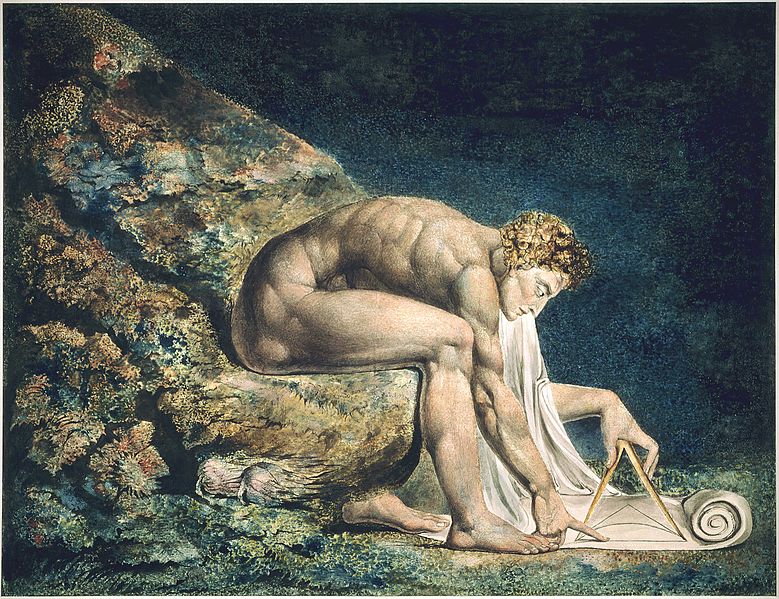
Newton by William Blake. Public domain.
By using only compass and straightedge, you become part of an ancient tradition.

Quick Question:
Do you prefer using a compass and a straightedge to draw geometric diagrams, or would you rather freehand?

Most of the people I know freehand. I would posit that the simple reason is that geometric construction isn't a topic touched upon at great length in most of our classrooms, and dabbling with the compass is mostly done in drafting class (that is, if you had one; I didn't.). When it comes, however, to people who deal with more elaborate [Difficulty 4+ in this blog] geometry problems on a regular basis, the question does become a tad more relevant. The figures get quite complicated, and for some, the best way to make any sense out of anything is to draw them as precisely as possible. Hence constructing.

Friday, October 24, 2014

Problem Post 2-2: A Sampler of `Olympiad' Geometry Concepts

Problem Posts
[Level 4]
Henry
This post is meant to be a `sampler' of sorts, to show the most common tag words one will see in olympiad geometry problems.
I've been fortunate enough to find two remarkable problems, and solve them in ways that form a whirlwind tour of the subject. The first problem demonstrates side chasing, isosceles triangles, some cyclic quadrilaterals and spiral similarity. The second problem demonstrates power theorems, cyclic quadrilaterals, collinearity, and triangle geometry.

Problem 1

This one comes from Andreescu and Gelca's Mathematical Olympiad Challenges.

QUESTION
(Andreescu, Gelca) Let $B$ and $C$ be the endpoints and $A$ the midpoint of a semicircle. Let $M$ be a point on the line segment $AC$, and $P$, $Q$ the feet of the perpendiculars from $A$ and $C$ to the line $BM$, respectively. Prove that $BP=PQ+QC$.

Tuesday, December 31, 2013

Problem 1-9: Triangle Side Expression

Problem Posts

QUESTION
(Hong Kong Team Selection Test 2009) Let $a$, $b$, $c$ be the sides of a triangle. Determine all possible values of $$\frac{a^2+b^2+c^2}{ab+bc+ac}$$


Laconic Solution Sketch
Apply Triangle Inequality, or Ravi Transformation.

Tuesday, December 10, 2013

Problem 1-6 Romance of a Right Triangle

Problem Posts

QUESTION
(Canadian Mathematical Olympiad 2013, Problem 3) Let $G$ be the centroid of a right-angled triangle $ABC$ with $\angle BCA = 90^{\circ}$. Let $P$ be the point on ray $AG$ such that $\angle CPA = \angle CAB$, and let $Q$ be the point on ray $BG$ such that $\angle CQB = \angle ABC$. Prove that the circumcircles of triangles $AQG$ and $BPG$ meet at a point on side $AB$.

Laconic Solution Sketch.
Using similar triangles, we can show that this common point is the foot of the altitude on $AB$ from $C$.


Tuesday, December 3, 2013

Problems 1-4 Mass Points

Problem Posts
Problem 1-4 (Geometry) [Difficulty 1]

QUESTION
(Classic) $D$ bisects side $AB$ of triangle $ABC$. $E$ is on $AC$ so that $AE:EC=1:2$. $CD$ and $BE$ meet at $G$. Find $DG:GC$.

Overview
Mass Points.

Saturday, November 16, 2013

Problem 1-3 Coin Rotation

Problem Posts
Problem 1-3 (Geometry) [Difficulty 1] [PDF]

QUESTION
(Original) Three identical cylindrical barrels with radius $\sqrt{3}$ are placed tangent to each other (represented by circles $c_{1}$ , $c_{2}$ , $c_{3}$ .) A metal sheet $AB$ is placed just touching $c_{1}$ and $c_{3}$. A coin $c$ with radius $2-\sqrt{3}$  is placed on the floor tangent to $c_{2}$ and $c_{3}$  (see the diagram), and rolled without slipping about the barrels (so that the coin is rotating clockwise), going through plank $AB$, until it returns to its starting point. How many radians has the coin rotated? (For example, half a turn is $\pi$ .)

Overview
Separate the coin's rotation into two 'components'.

Problem 1-2 Ellipse Tracing

Problem Posts
Problem 1-2 (Geometry) [Difficulty 3] [PDF]


QUESTION
(Original) Define points $A\left(2,5+\sqrt{21}\right)$ , $B\left(2,5-\sqrt{21}\right)$ . Now let a point $P$ be initially at $P_{0}\left(4,5\right)$ . Let $Q$ be the point on ray $\overrightarrow{AP}$  such that $PB=PQ$ . As $P$ moves along the lower half of the ellipse $25x^{2}-100x+4y^{2}-40y+100=0$ (to eventually stop at $\left(0,5\right)$), the point $Q$  traces a path. Find the length of this path.


Overview/Laconic Solution Sketch
Apply geometric ellipse definition, and from that calculate arc length.